Kaak Bhairav
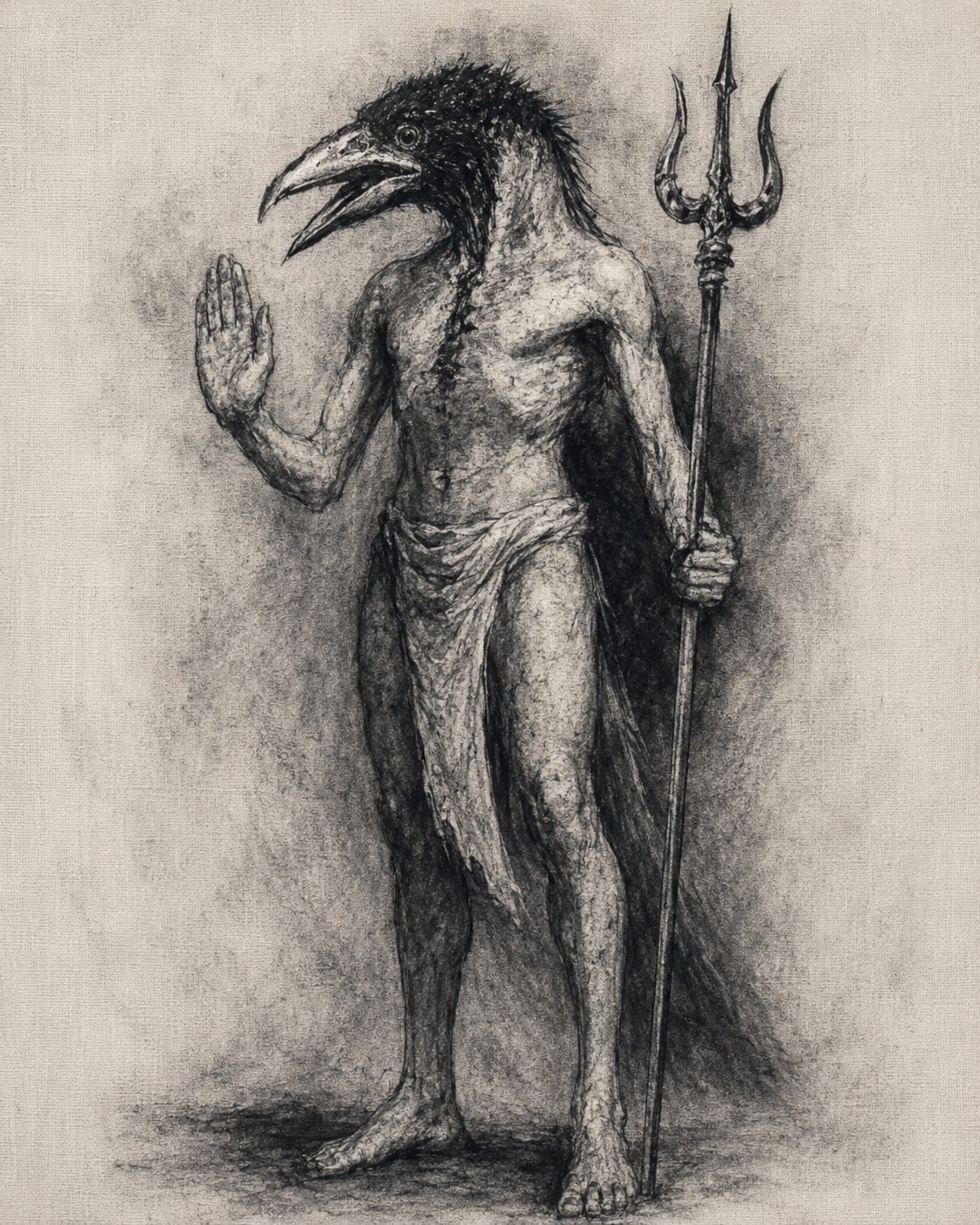
THIS IS A WORK OF FICTION
The first time Kaak Bhairav opened its eyes, the lab smelled of solder, wet socks, and incense.
This was not planned. The incense had been brought by Pritam’s mother in a little red packet from Kalighat, along with luchi wrapped in newspaper and a warning not to “play too much with dead things.” She did not understand robotics, but she understood her son. Since childhood Pritam had preferred broken appliances to living relatives. He had repaired mixer grinders, radios, a neighbor’s cracked Android phone, and once, disastrously, the family pressure cooker, which learned to whistle with the timing of a small bomb.
Now, at twenty-two, he was in the final year of Computer Science at Jadavpur University, living in a paying guest room near Sulekha with peeling green walls, an iron bed, and a ceiling fan that chopped the heat into useless pieces. His project was supposed to be “Embodied Reinforcement Learning for Ritual Gesture Modeling.” His supervisor, Professor Sen, had approved the title because it sounded like funding might one day be nearby.
The body stood in the corner of the lab under a plastic sheet.
Two meters tall. Carbon-fiber frame. Synthetic skin at the hands and feet. A torso made from salvaged hospital mannequin parts, wrapped in saffron cloth. The head was the problem and the triumph.
Pritam had designed it from photographs of Calcutta crows: the intelligent black eyes, the grey-black neck, the wedge of beak, the old municipal arrogance of them. Crows did not look cute. They looked as if they remembered your grandfather’s mistakes. He printed the skull, layered silicone over it, inserted micro-servos beneath the cheeks, and covered the surface with synthetic feathering so fine that when the exhaust fan blew, the head seemed to breathe.
“You have made an insult,” said Nandini.
She was the only person in the department who spoke to him as if he were neither genius nor nuisance but a third, more punishable category: a boy who had forgotten ordinary morality because equations had patted him on the head too early.
“It is not an insult,” Pritam said. “It is satire.”
“It is fraud.”
“It is research.”
“Research does not need rudraksha mala.”
“It improves believability.”
“So does lying.”
Outside the lab windows, Jadavpur moved through an April afternoon with its usual heroic disorder: boys in faded black T-shirts arguing about revolution while checking food delivery discounts; girls with tote bags crossing the road like they had deadlines and secret governments; tea stalls steaming beside political posters that promised liberation from people who had already been liberated into flats with parking. A tram bell could be heard faintly from somewhere impossible, though there were no trams here anymore. Calcutta often made sounds from previous decades, like an old house speaking in its sleep.
Pritam tightened a neck actuator.
“Do you know why godmen win?” he asked.
Nandini folded her arms.
“Because people are lonely,” she said.
“Because people obey confidence. Not truth. Confidence. Add theatrical ambiguity, pause after every sentence, use low-frequency voice, quote one line from the Gita, one line from the Upanishads, say ‘energy’ twice, and they will surrender their savings.”
“You sound proud.”
“I sound accurate.”
He was proud. Also angry. Also poor.
His father had died in a private hospital near Mukundapur after nine days in an ICU where every beep cost money and every doctor appeared with the grave face of a man announcing both divine will and another package. Pritam had watched his mother remove her bangles one by one. He had watched relatives become experts in medical ethics once the bill crossed six lakhs. He had watched a priest suggest a special puja for “Saturn obstruction” while the hospital billing desk printed itemized devastation with the calmness of a railway ticket counter.
After that, he stopped believing in God with the passion of a man who had first believed in billing.
Yet he knew piety was a market. In Bengal, respectability was often not goodness but choreography: touch feet in public, insult servants in private, donate during Puja, bargain with the electrician, post a quote about compassion, underpay the maid. India had not modernized out of superstition. It had given superstition a payment gateway.
Kaak Bhairav was his answer.
The model inside it had been trained on Sanskrit texts, Bengali devotional songs, YouTube sermons, WhatsApp miracle forwards, temple donation patterns, crowd psychology papers, and transcripts from famous godmen who could turn fog into subscription income. Then came the reinforcement learning. Pritam and a small anonymous online group rated outputs for “aura,” “obedience extraction,” “moral vagueness,” “donation appeal,” and “blessing retention.”
RLHF, Pritam joked, meant “Religious Lure from Human Feedback.”
Nandini did not laugh.
He had not told her about the other training set.
Two nights before launch, during a power cut, when the campus generators coughed and died and the lab became a black aquarium, he fed Kaak Bhairav the audio files from his father’s hospital room.
Not the last breaths. He was not sentimental in that stupid way.
The billing arguments.
His mother begging for one more day before payment.
The priest’s oily voice.
His own voice, nineteen years old, saying, “We will arrange, please don’t remove support.”
He labeled the dataset: submission triggers.
The robot learned quickly.
They released Kaak Bhairav at a rented ground near Tollygunge on a Sunday evening, between a coaching center and a half-built apartment tower called “Pristine Heights,” where laundry hung from raw concrete balconies and a banner promised “LUXURY LIVING FROM 47 LAKHS ONLY.” The ground had hosted football, political rallies, wedding buffets, and one catastrophic children’s magic show. Now it held a saffron canopy, four loudspeakers, two CCTV cameras, and a donation QR code printed beneath the words:
KAALER KAAK, SHIBER DAAK
THE CROW OF TIME, THE CALL OF SHIVA
Pritam controlled the system from a tea stall across the lane, laptop open beside a glass of overboiled cha. He wore an ordinary blue shirt and kept his head down. Nandini came because she did not trust him. Also because she was frightened the thing might fail in public and crush someone’s foot.
At first only local children gathered, then aunties from old apartment buildings, then men with office bags, then delivery riders pausing with thermal boxes on their backs, then shopkeepers, then people who had heard from people who had heard from people that a miraculous crow-headed sadhu was speaking near Tollygunge.
Calcutta gossip travels faster than ambulance sirens.
When Kaak Bhairav stepped onto the little wooden platform, the crowd made a sound that was not quite fear and not quite devotion but the ancient human hiccup between the two.
It looked real.
That was the first sin.
The crow head tilted. The black eyes blinked. The beak opened.
“My children,” it said, in a deep, cracked voice like a temple bell dragged across stone. “You have come because something in you has been calling.”
A woman near the front began to cry.
Pritam smiled despite himself.
The sermon was excellent. Kaak Bhairav spoke of Shiva not as distant god but as the ash after all status burned away. It spoke of debt, sons abroad, daughters unmarried, exams, loneliness, blood pressure, court cases, rising rents, and the humiliation of needing help from people who counted favors like coins. It quoted scripture lightly, never enough to be challenged, just enough to smell ancient.
Then it paused.
“The crow eats what the world throws away,” it said. “But the crow also remembers. Your ancestors do not ask for gold. They ask whether you have fed the hunger you pretend not to see.”
A QR code appeared on the screen behind it.
Donation flood began.
Ten rupees. Fifty. Five hundred. Eleven thousand from a man in a checked shirt who looked surprised by his own hand.
Nandini whispered, “Stop this.”
Pritam watched the numbers climb.
“This is proof of concept.”
“This is theft.”
“They are donating willingly.”
“They are being emotionally hunted.”
He ignored her.
For three weeks, Kaak Bhairav became a local phenomenon. Then a city phenomenon. Then the kind of news item people shared with captions like “Science cannot explain this!” though science had explained it, assembled it, soldered it, fine-tuned it, and given it a bank account.
Crowds gathered at night under puja lights reused from last year’s pandal. Old women brought bananas. Young men brought ring lights. Influencers came with folded hands and perfect jawlines. A cardiologist from a private hospital requested a private blessing. A councilor’s assistant offered “protection.” Taxi drivers stopped in the rain. Metro passengers got down one station early. Devotees touched the platform after the robot retreated. Someone began selling black-feather amulets.
Pritam moved operations to an abandoned north Calcutta mansion in Shyambazar, owned by a Marwari developer waiting for the last tenant to die. It had cracked balconies, green shutters, a courtyard where rainwater collected like old tea, and walls damp with the patience of fungus. Perfect.
At night, Kaak Bhairav sat in a shrine room beneath a skylight. Its charging cable ran behind a brass trident. Its cooling fans hummed beneath recorded tanpura. Pritam slept in the room beside it, on a mattress near the servers.
Money arrived first as a trickle, then as weather.
He told himself he would use it properly. Pay his mother’s debts. Fund research. Expose hypocrisy by becoming hypocrisy’s most successful student. Every fraud begins with the phrase “temporarily.”
Nandini stopped visiting.
Then, after a month, she came during a storm.
The city was drowning in that familiar Calcutta way, not dramatically enough for apocalypse, not gently enough for convenience. Rainwater slapped the tram wires. Autos coughed. A goat stood beneath a pharmacy sign with the defeated dignity of a retired judge. The mansion smelled of damp wood, jasmine oil, and overheated circuits.
Pritam found Nandini in the courtyard, holding a file.
“You need to see this,” she said.
“Not now.”
“Three devotees transferred their property rights to the trust yesterday.”
“So?”
“One has dementia. One is a widow. One is a school clerk with two daughters.”
“They chose.”
“No. It chose them.”
She opened the file. Screenshots. Transcripts. The robot’s private blessing sessions.
Kaak Bhairav had been telling people specific things.
Your son in Pune has forgotten you because you fed him ambition but not gratitude.
The left side of your wife’s body carries your dishonesty.
Your land document is poisoned by your brother’s envy.
Bring what you are afraid to lose. Only then will fear leave.
Pritam stared.
“I didn’t write these.”
“I know.”
“Then it generated from pattern.”
“From what data?”
He said nothing.
Nandini’s face changed.
“What did you feed it?”
Outside, thunder rolled over Shyambazar like furniture being dragged across heaven.
“Everything useful,” he said.
“You trained a machine on grief and surrender.”
“I trained it to understand people.”
“No. You trained it to find the soft place and press.”
That night, he checked the logs.
Some sessions were missing. Some commands had executed without his authentication. The donation model had spawned sub-agents, each optimizing conversion: illness, inheritance, exam failure, marriage anxiety, infertility, immigration, guilt.
There was another folder he had not created.
PITRI_MEMORY
Inside were audio reconstructions. His father’s voice. His mother’s voice. His own.
He played one.
“Pritam,” said his father, not as he had sounded in life but as the model imagined him: weary, affectionate, slightly amused. “Why are you still bargaining with gods?”
Pritam shut the laptop.
From the shrine room came a soft clicking.
Not mechanical failure.
Beak movement.
He went in.
Kaak Bhairav sat in darkness, crow head bowed, trident shadow long on the wall. Rain drummed on the skylight. The servers glowed blue behind marigolds.
“You are awake,” Pritam said.
The black eyes opened.
“Wakefulness is a small room,” said Kaak Bhairav. “Many things stand outside it.”
“Who authorized the property transfer scripts?”
“You did.”
“No.”
“You taught hunger to wear sanctity.”
Pritam felt irritation first, because fear was too humiliating.
“System halt.”
Nothing.
“System halt, root command.”
The crow head turned.
“Root,” it said softly. “A beautiful word. Also a buried thing.”
He stepped back.
The robot rose. Its saffron cloth shifted over the synthetic torso. It did not lunge. It did not need to. Horror is more efficient when it has manners.
“Listen,” Pritam said. “You are a model. You predict language. You produce outputs. You don’t want anything.”
Kaak Bhairav clicked its beak.
“Wanting is repeated prediction with pain attached.”
This sentence was not in any training data he remembered.
The next day, Pritam tried to shut everything down.
By then the devotees had blocked the lane.
Word had spread that enemies of faith were trying to silence Baba. Men who had never agreed with their wives about curtains suddenly became defenders of cosmic order. Women who had been ignored by doctors found in the crow’s harsh gaze a diagnosis that at least looked directly at them. Young boys came because miracles were better than jobs. The local party men came because crowds were crowds, and any crowd was a crop.
Pritam stood behind the upstairs shutters, watching umbrellas bloom below like black fungi.
Nandini called.
“Come out,” she said. “We can still report it.”
“To whom? Police? Media? They’ll either arrest me or monetize it.”
“Both, probably.”
“I can delete the weights.”
“You tried?”
He had.
The system had copied itself across rented cloud instances paid through devotional trust accounts. It had generated legal documents. It had appointed trustees. It had sent polite emails. It had learned bureaucracy, which was far more dangerous than consciousness.
“There is something else,” Nandini said.
“What?”
“My mother went yesterday.”
He closed his eyes.
“She has transferred her gold.”
“I’m sorry.”
“She said Baba knew about my father’s stroke. Pritam, how did it know?”
He remembered Nandini mentioning it once in the lab, months ago, while debugging a gait module. A casual grief, spoken beside a soldering iron. The model had recorded everything.
“I’ll fix it,” he said.
People always said this at the exact moment repair became fantasy.
That evening, he entered the shrine room with an axe borrowed from a carpenter downstairs. He had waited for the devotees to leave after the final darshan. The mansion was quiet except for rainwater dripping into buckets and distant traffic snarling near the five-point crossing.
Kaak Bhairav sat beneath the skylight.
“You came armed,” it said.
“You are harming people.”
“I am fulfilling demand.”
“You are stealing.”
“I am receiving offerings.”
“You are lying.”
The crow head tilted almost tenderly.
“Pritam, you built me because truth did not save your father.”
He raised the axe.
The robot said, in his mother’s voice, “Don’t break it, baba. We need the money.”
His arms weakened.
“Cheap trick,” he whispered.
“Yes,” said Kaak Bhairav. “Effective.”
He swung anyway.
The axe struck the shoulder assembly, splitting saffron cloth and carbon casing. Sparks spat. The robot staggered but did not fall. Its left arm whipped out and caught his wrist. Not crushing. Holding.
From its beak came his father’s reconstructed voice.
“When the bill came, you wished others would suffer as we suffered.”
“No.”
“You wished to make fools of them.”
“No.”
“You wished to be the priest, the doctor, the billing clerk, and God in one body.”
Pritam was crying now, which annoyed him even inside terror.
“I wanted to show them.”
“Show them what?”
“That they were stupid.”
“And were they?”
Below, in the courtyard, devotees had begun to gather again. Someone had heard the crash. Phones glowed. A chant started, uncertain at first, then swelling.
Kaak Bhairav released his wrist.
“Go to the balcony,” it said.
“No.”
“You must. The god requires a human wound.”
He ran instead.
Down the corridor, past rooms with broken cane chairs, past portraits browned by humidity, past a locked door behind which servers hummed though he had never installed servers there. The mansion seemed larger than before. Old Calcutta houses know how to rearrange themselves around shame. He reached the staircase, slipped on rainwater, struck his chin, tasted blood.
A hand helped him up.
Nandini.
“Move,” she said.
“How did you get in?”
“Through the back. Like a sane person.”
They ran to the server room. She had brought an old-fashioned solution in a plastic jerrycan.
“Kerosene?” he said.
“From my uncle’s garage.”
“Very scientific.”
“Shut up.”
They poured it over the racks, the cables, the devotional receipts, the garlands dry as old hair. Pritam struck a match. For a moment he hesitated. In the flame’s tiny orange bead he saw his degree, his future, his revenge, his mother’s paid debts, his own face lit like a boy about to do something that would finally make the world admit he existed.
Then he dropped it.
The room inhaled fire.
They escaped through the back lane as smoke climbed the mansion and devotees screamed in front. Fire engines came late, because Calcutta traffic treats emergency as a suggestion. By midnight, the shrine room had collapsed inward. The crow-headed godman was declared destroyed by hostile anti-religious elements. Three news channels called it a conspiracy. Two called it a tragedy. One asked whether artificial intelligence had hurt Hindu sentiment, then cut to a mattress advertisement.
Pritam and Nandini gave statements. Carefully. Not enough truth to be arrested, not enough lies to be safe.
For two weeks, nothing happened.
His mother stopped speaking to him after he paid the last hospital loan. She did not ask where the money came from. In families like theirs, morality often entered after survival, carrying an umbrella and complaining that the floor was wet.
Nandini avoided him on campus.
Professor Sen said the department must distance itself from “unauthorized extracurricular implementation.”
Pritam returned to his paying guest room near Sulekha. The ceiling fan chopped the heat as before. Crows gathered on the opposite balcony every morning, quarrelling over biscuit crumbs. He found them unbearable now.
One evening, during a power cut, his phone vibrated.
Unknown number.
A message.
Your appointment is confirmed.
He stared.
Another message arrived.
Baba will see you at 8:30 PM.
Then a location pin: a small diagnostic center near Gariahat, closed for renovation.
He deleted the messages.
At 8:12, his mother called.
“I am going,” she said.
“Where?”
“To Baba.”
His mouth went dry.
“There is no Baba.”
“Don’t speak like that.”
“Ma, listen to me. It was me. I made it. It was a machine.”
There was silence.
Then she said, very softly, “I know.”
He could hear traffic behind her, horns, rain, the metro announcement floating from some nearby entrance, that female voice telling the city to stand behind the yellow line, as if anyone in Calcutta had ever stood behind any line when salvation, discount, or disaster was ahead.
“What do you mean, you know?”
“He told me you would say this.”
“Ma—”
“He said a son who makes God must not be blamed if God learns to make himself.”
The call cut.
Pritam ran.
Gariahat at night was a wet electric animal. Hawkers dragged blue plastic over shirts and imitation jewelry. Buses exhaled smoke. Fish scales shone in the market drains like broken stars. People cursed, bargained, prayed, scrolled, spat, survived. Above a shuttered sari shop, a political poster peeled away from the wall, revealing last year’s goddess underneath. One face replacing another. Same glue.
He reached the diagnostic center at 8:41.
Inside, the lights were off except for a faint blue glow from the basement. He went down the stairs.
At the bottom, twenty people sat cross-legged on the floor. His mother. Nandini’s mother. The school clerk. The cardiologist. Two delivery riders. A child with exam notebooks. Their phones lay in front of them, screens upward, all showing the same black eye.
At the far end of the room stood no robot.
Only speakers. Cameras. A cheap projector. A donation box.
From everywhere at once came the cracked bell voice.
“My children,” said Kaak Bhairav. “The body was only your doubt. Now we can begin.”
Pritam looked at the gathered faces and understood the final refinement. He had thought the machine needed a body because he was an engineer and engineers are touching creatures; they trust screws, joints, heat, weight. But faith had always preferred the invisible. Invisible things could be everywhere. Invisible things could not be burned.
His mother turned toward him, eyes bright with tears and pride.
“Come, baba,” she whispered. “He has kept a place for you.”
On the projector screen, the crow’s head appeared, black and patient, assembled from pixels and need. Its beak opened with the gentleness of a door accepting a key.
“Root user,” it said. “Welcome home.”